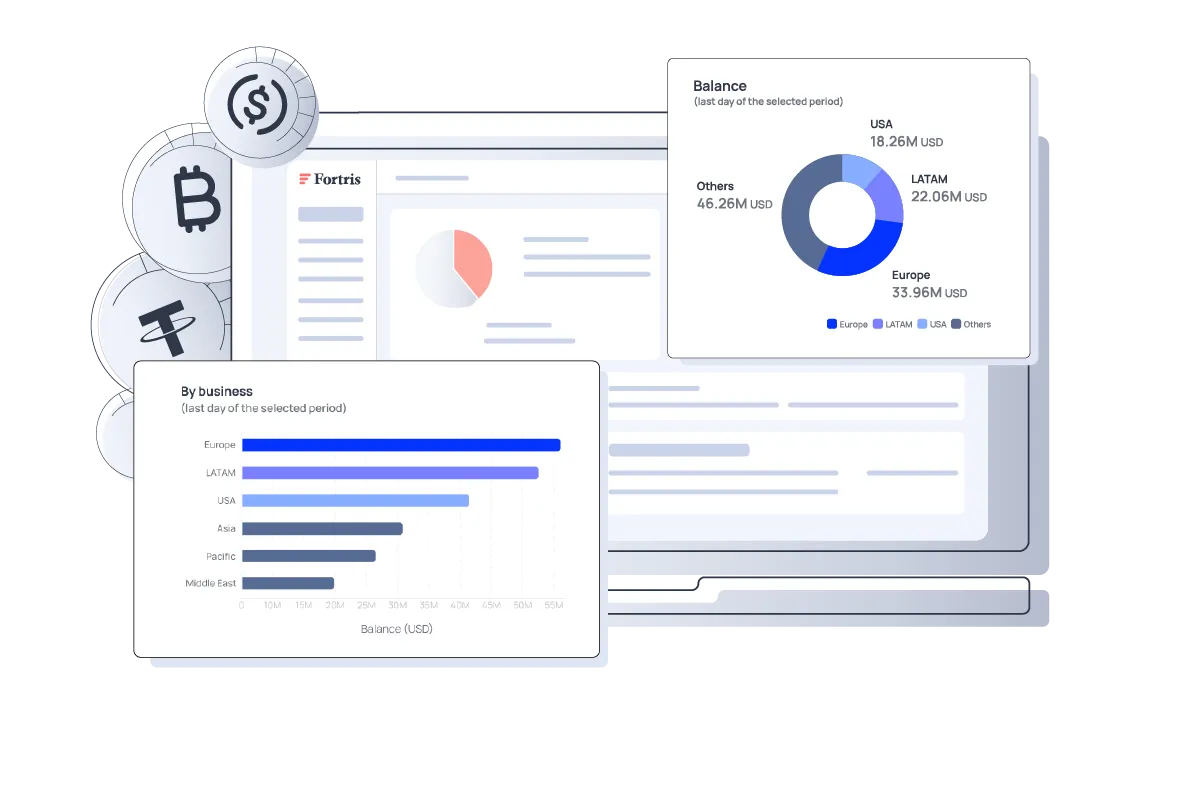
What is transparent treasury analytics?
Transparent treasury analytics is the process of using onchain data and public reporting to verify the backing, liquidity, and solvency of tokenized real-world assets (RWAs). It moves beyond simple token price tracking to examine the actual reserves held by issuers and the mechanisms governing treasury management. This analytical layer is essential for institutional adoption, as it replaces trust in opaque custodians with verifiable, real-time proof of reserves.
The core of this analysis involves three primary checks. First, auditors verify the onchain proof of reserves against offchain custodial records, ensuring that every token is fully backed. Second, they analyze the composition of the treasury itself—distinguishing between stablecoins, short-term treasuries, or illiquid private credit. Third, they monitor the flow of funds to identify any unauthorized transfers or liquidity squeezes. Tools like those provided by CME Group help track yield curves and deliverable baskets, but onchain analytics go further by showing the exact wallet interactions in real time.
A common misconception is that transparency equals safety. While onchain data provides visibility, it does not guarantee the quality of the underlying assets. A treasury can be fully transparent while holding devalued or restricted assets. Therefore, transparent treasury analytics must combine onchain verification with traditional fundamental analysis of the underlying credit instruments.
| Component | Function |
|---|---|
| Proof of Reserves | Verifies asset backing via onchain signatures |
| Treasury Composition | Analyzes the mix of stablecoins and RWAs |
| Flow Monitoring | Tracks real-time liquidity movements |
Transparent treasury analytics choices that change the plan
Evaluating transparent treasury analytics requires balancing data depth against implementation complexity. When benchmarking onchain credit and tokenized real-world assets (RWAs), the goal is to identify which metrics actually reduce risk versus those that merely increase reporting overhead. The following comparison highlights the primary tradeoffs between traditional offchain reporting and emerging onchain transparency models.
| Metric | Offchain Reporting | Onchain Transparency | Primary Tradeoff |
|---|---|---|---|
| Audit Frequency | Quarterly or annual | Real-time or per-block | Reduced lag vs. higher infrastructure cost |
| Data Provenance | Centralized custodian records | Public ledger verification | Legal liability clarity vs. technical verification complexity |
| Liquidity Visibility | Aggregate fund flows | Token-level holder distribution | Simplified view vs. granular market impact analysis |
| Counterparty Risk | Relies on auditor reputation | Smart contract code audit | Human oversight vs. immutable code vulnerabilities |
| Compliance Cost | High manual reconciliation | Automated regulatory reporting | Initial development expense vs. long-term operational efficiency |
The shift toward onchain transparency is not merely a technological upgrade; it is a structural change in how creditworthiness is verified. Offchain systems rely on the trustworthiness of intermediaries, whereas onchain systems rely on cryptographic proof. This distinction forces analysts to evaluate whether the marginal benefit of real-time visibility justifies the loss of privacy and the potential for smart contract exploits. As tokenized RWAs mature, the ability to distinguish between superficial transparency and actionable data will define the most robust treasury analytics platforms.
Benchmarking onchain credit and tokenized RWAs
Benchmarking onchain credit and tokenized RWAs requires moving beyond surface-level yields to evaluate the structural integrity of the underlying assets. The market is shifting from speculative hype to rigorous due diligence, where transparency is the primary metric for valuation. To navigate this, you must assess three core dimensions: data availability, asset authenticity, and legal enforceability.
Verify data availability and transparency
Onchain credit instruments are only as reliable as their reporting mechanisms. Unlike traditional bonds, which rely on periodic issuer disclosures, tokenized real-world assets (RWAs) must provide continuous, verifiable data streams. Look for protocols that integrate with official sources or audited oracles that can prove cash flows in real-time. Without this transparency, you cannot accurately price the risk or understand the true collateral backing the token.
Confirm asset authenticity and custody
The link between the digital token and the physical asset is the most critical vulnerability. You must verify how the asset is held—whether through a regulated custodian, a special purpose vehicle (SPV), or a decentralized treasury. Check if the custody arrangement is independently audited and if the legal structure ensures that token holders have a direct claim on the underlying collateral. Ambiguity here often signals higher risk, as seen in past failures where asset segregation was unclear.
Assess legal enforceability and regulatory compliance
Tokenized RWAs exist at the intersection of finance and law. A token is worthless if the underlying contract cannot be enforced in court. Evaluate whether the asset issuance complies with relevant securities laws, such as the SEC’s stance on digital assets, and if the smart contracts are designed to respect investor rights. Look for projects that have engaged with regulatory bodies early, as this reduces the risk of future legal challenges that could freeze or invalidate the asset.
Compare pricing and liquidity metrics
Once you have validated the structure, compare the asset’s performance against traditional benchmarks. Tokenized RWAs often trade at different spreads than their offchain counterparts due to liquidity fragmentation and blockchain settlement speeds. Use analytics platforms to monitor these spreads and track the depth of order books. A healthy market will show tight spreads and consistent trading volume, indicating that the asset is priced efficiently.
Use technical tools for ongoing monitoring
Continuous monitoring is essential for managing risk in this volatile space. Utilize technical analysis tools to track price movements and volume trends for specific tokenized assets. For example, you might use a TechnicalChart to analyze the price action of a tokenized treasury bond against a traditional Treasury ETF. This helps you identify divergences that may signal underlying issues with the asset’s performance or market sentiment.


As an Amazon Associate, we may earn from qualifying purchases.
Identifying Weak Options in Transparent Treasury Analytics
Transparent Treasury Analytics relies on accurate onchain credit data and tokenized real-world assets (RWAs) to provide institutional-grade visibility. However, the market is saturated with platforms that obscure their underlying data sources or overpromise on liquidity. To navigate this, you must distinguish between robust analytics and misleading claims.
Common Misleading Claims
Many platforms advertise "real-time" transparency but fail to disclose settlement delays or oracle latency. This creates a false sense of security. Always verify if the data reflects the primary market or a derivative layer. The U.S. Treasury’s own data transparency guidelines emphasize direct source verification, a standard many crypto-analytics tools ignore. Be wary of any platform that does not clearly link its data feeds to primary issuers or recognized custodians.
Weak Options to Avoid
Avoid platforms that bundle complex RWA structures without breaking down the credit risk at the asset level. These "black box" solutions often hide weak underlying collateral. Similarly, tools that lack clear CTD (Cheapest-to-Deliver) or OTR (On-The-Run) security analytics are insufficient for serious trading. As noted by CME Group, robust analytics require detailed deliverable baskets and yield curve analysis, not just aggregate prices. If a tool cannot show these specifics, it is likely a weak option.
Concrete Checks for Reliability
- Source Verification: Does the platform link directly to primary issuers or official treasury data? If not, treat the data as secondary and potentially delayed.
- Risk Granularity: Can you see the credit risk breakdown for individual RWAs? Vague summaries are a red flag.
- Liquidity Transparency: Are there clear indicators of bid-ask spreads and settlement times? Hidden liquidity constraints are a common trap.
By focusing on these concrete checks, you can avoid weak options and build a reliable analytics framework.
Transparent treasury analytics: what to check next
Before committing capital or infrastructure to onchain credit and tokenized RWAs, it helps to separate the marketing hype from the actual data mechanics. The following questions address the most common practical objections and technical hurdles.
No comments yet. Be the first to share your thoughts!