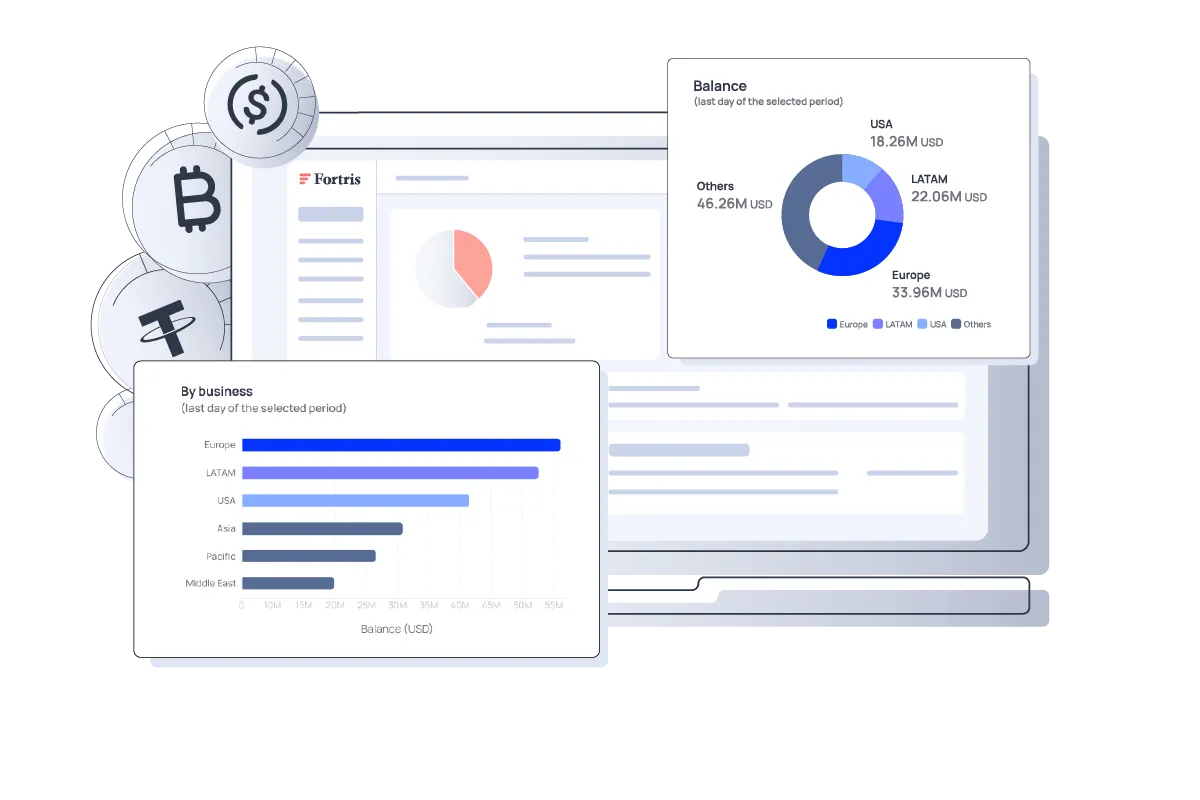
Transparent treasury analytics strategy
Treasury teams are shifting from retrospective reporting to real-time visibility. By integrating onchain credit data and tokenized real-world assets (RWAs) into treasury management systems, CFOs can monitor liquidity and risk with granular precision.
The core of this strategy relies on three operational pillars:
Automated liquidity mapping. Instead of waiting for end-of-day bank statements, systems pull data directly from blockchain ledgers and connected banking APIs. This allows treasurers to see available cash across multiple jurisdictions instantly, reducing idle balances and optimizing short-term investment decisions.
Onchain credit verification. Traditional credit checks rely on quarterly financial statements that may be months old. Onchain analytics provide real-time proof of reserves and transaction history for counterparties. This enables treasurers to assess counterparty risk dynamically, adjusting credit limits based on current onchain activity rather than historical filings.
RWA-backed collateral efficiency. Tokenizing assets like commercial paper or bonds allows for fractional ownership and instant settlement. Treasurers can use these tokenized instruments as collateral for short-term funding needs, unlocking value trapped in illiquid assets without waiting for traditional settlement cycles.
Implementing this strategy requires a shift in infrastructure. Treasury teams must adopt tools that can interpret blockchain data alongside traditional ERP outputs. The goal is a unified view where onchain and offchain assets are managed under a single analytical framework, reducing manual reconciliation and improving decision speed.
Key tradeoffs in transparent treasury analytics
When integrating onchain credit and RWA tokenization into corporate treasury, the primary challenge is balancing liquidity access against operational complexity. Traditional treasury analytics rely on siloed bank feeds and static ERP data, which often lag real-time market movements. Transparent treasury analytics shifts this paradigm by providing immutable, real-time visibility into asset backing and settlement status. However, adopting this level of granularity requires careful evaluation of several concrete factors.
Data Granularity vs. Privacy
Onchain transparency offers granular, second-by-second visibility into asset movements, but this comes with significant privacy implications for sensitive corporate transactions. Public ledgers expose transaction patterns that competitors or bad actors could analyze to infer strategy. Traditional private banking relationships offer some opacity, but at the cost of delayed reporting. The tradeoff here is between the strategic advantage of real-time data and the risk of exposing sensitive financial maneuvers. Most enterprises opt for permissioned ledgers or zero-knowledge proof implementations to maintain necessary privacy while retaining auditability.
Settlement Speed vs. Regulatory Compliance
Tokenized assets can settle in minutes, compared to the T+2 standard for traditional securities. This speed reduces counterparty risk and frees up trapped capital. However, regulatory frameworks for RWA tokenization are still evolving. Ensuring that automated smart contract executions comply with KYC/AML requirements and local securities laws adds a layer of complexity that manual processes often bypass. Companies must weigh the liquidity benefits against the potential legal exposure of non-standard settlement mechanisms.
Integration Complexity vs. Operational Efficiency
Integrating onchain data streams with existing Treasury Management Systems (TMS) requires significant engineering resources. While the long-term goal is automated reconciliation and reduced manual labor, the initial setup involves mapping onchain events to offchain accounting entries. Traditional systems are designed for batch processing, not the continuous, event-driven nature of blockchain data. The tradeoff is a high initial technical debt for the promise of streamlined, real-time operational efficiency.
Cost Structure vs. Yield Potential
Tokenization can reduce intermediary fees, potentially increasing net yield on idle cash or assets. However, gas fees, smart contract auditing costs, and custody solutions add new expense lines. For smaller treasuries, these fixed costs may outweigh the marginal yield improvements. Larger entities benefit more from scale, as the reduction in friction and counterparty risk becomes more valuable than the operational overhead.
Transparent treasury analytics offers real-time visibility and faster settlement but requires navigating privacy concerns, regulatory uncertainty, and complex integration. The strategy tradeoff centers on whether the operational efficiency gains justify the initial technical and compliance overhead.
How to build a transparent treasury analytics framework
Moving from traditional reporting to onchain credit and RWA tokenization requires a structured approach. You cannot simply plug in new data sources without defining the underlying logic for liquidity and risk. This decision framework breaks down the implementation into five practical steps, focusing on data integrity, regulatory alignment, and operational efficiency.
-
Audit and clean legacy data. Before tokenizing assets, map your existing data sources. Treasury data analytics often fail because legacy systems (ERP, banking portals) do not speak the same language. Identify which data points—cash positions, receivables, or debt obligations—are already digitized and which require manual reconciliation. Clean this data first; onchain transparency amplifies existing inaccuracies.
-
Select compliant infrastructure. Choose a blockchain infrastructure that aligns with your compliance needs. Private permissioned ledgers offer faster settlement and data privacy for institutional investors, while public chains provide broader liquidity and auditability. Evaluate the gas costs, finality times, and smart contract security audits of potential platforms. The goal is to balance the immutability of onchain records with the regulatory flexibility required for corporate finance.
-
Define onchain credit metrics. Traditional credit scores do not translate directly to onchain environments. Define specific, measurable metrics for creditworthiness, such as real-time liquidity ratios, debt-service coverage, and asset utilization. These metrics must be updated automatically via oracles or API integrations to reflect the true state of the treasury. This shift allows lenders to price risk dynamically rather than relying on quarterly financial statements.
-
Deploy live verification dashboards. Replace static PDF reports with live dashboards that visualize the tokenized assets and their underlying performance. Stakeholders, including auditors and investors, need instant access to verified data. Ensure the dashboard can handle complex queries, such as tracing the flow of funds from token issuance to final settlement. This transparency reduces the time spent on external audits and builds trust with institutional partners.
-
Implement privacy-preserving controls. Onchain transparency does not mean public visibility of all data. Implement privacy-preserving technologies, such as zero-knowledge proofs, to verify compliance without exposing sensitive trade secrets. Ensure your framework adheres to relevant regulations, such as SEC guidelines for digital assets or MiCA in Europe. Regularly audit your smart contracts and data flows to maintain regulatory standing and avoid legal penalties.
Applying this framework ensures that your transition to transparent treasury analytics is not just a technological upgrade, but a strategic realignment of how you manage corporate liquidity and risk. By focusing on data quality and regulatory alignment, you create a foundation for scalable, onchain credit strategies.
Common pitfalls in treasury analytics
As onchain credit and RWA tokenization enter the mainstream, many vendors wrap legacy reporting in new terminology. The result is often a dashboard that looks modern but lacks the depth needed for actual treasury strategy. Before committing to a 2026 analytics stack, you need to separate signal from noise.
Here are three common traps that undermine transparent treasury analytics.
The "Black Box" Algorithm
Many platforms promise "AI-driven insights" but refuse to explain how their models weight cash flow variables. In treasury, opacity is a liability. If you cannot trace why a liquidity forecast shifted, you cannot defend it to the board. Look for providers that allow you to adjust the underlying assumptions. If the tool hides its logic, it is not analytics—it is a guess.
Static Dashboards Disguised as Real-Time
Tokenization enables true real-time settlement, yet many "modern" treasury tools still rely on batch-processed data from overnight bank feeds. A dashboard that updates once a day is not transparent; it is a snapshot of the past. Ensure your analytics engine ingests live bank and blockchain data. If the numbers lag by hours, you are making decisions based on yesterday's reality.
Ignoring the Compliance Layer
RWA tokenization introduces complex regulatory boundaries. Some analytics tools ignore the compliance layer, focusing only on P&L. This is a critical oversight. Your analytics must integrate with compliance frameworks to flag jurisdictional risks in real time. Without this, you risk automating regulatory breaches. Transparency means seeing both the profit and the potential penalty.
No comments yet. Be the first to share your thoughts!