Defining treasury data analytics
Treasury data analytics is the practice of collecting, processing, and analyzing financial data from multiple sources to support decision-making. Traditionally, this meant aggregating bank statements, cash flow statements, and general ledger entries to forecast liquidity. Today, the definition has expanded to include real-time data ingestion from digital asset wallets and onchain ledgers.
The core challenge is no longer just aggregation, but velocity. Corporate treasury is shifting toward infrastructure that delivers faster liquidity deployment and better transparency. This means moving away from end-of-day batch processing to continuous monitoring of cash positions across both fiat and crypto holdings.
For CFOs, this shift transforms treasury from a back-office accounting function into a strategic partner. By integrating traditional banking data with onchain analytics, organizations can see their true liquidity position instantly. This clarity allows for more efficient capital allocation and risk management in a volatile market environment.
Why transparency matters for RWA
Tokenized real-world assets (RWA) bridge two very different worlds: the traditional financial system and blockchain networks. For institutional investors, the bridge only works if the path is clear. Opaque infrastructure creates a trust gap that no amount of marketing can fill. When asset owners cannot see the underlying data, they cannot verify the asset's health, leading to hesitation or outright rejection of the technology.
Transparency in treasury analytics solves this by providing a single source of truth. It allows stakeholders to verify that on-chain tokens are fully backed by off-chain assets in real time. This visibility is not just a technical feature; it is a regulatory requirement. The US Treasury and the Federal Reserve have long emphasized that market monitoring and surveillance rely on accurate, timely data to maintain order.
The New York Fed’s research on data availability highlights how official sector uses of Treasury data promote fair and efficient markets. In the context of RWA, this means that tokenized treasuries must offer the same level of auditability as their traditional counterparts. Without transparent infrastructure, the market cannot scale beyond niche participants. The goal is to make the digital twin indistinguishable from the physical asset in terms of reliability and oversight.
Regulatory compliance is the next hurdle. The Treasury’s recent innovation roadmap outlines strategies for countering illicit finance through standardized, secure data practices. Transparent analytics infrastructure aligns with these goals by providing immutable audit trails. This reduces the compliance burden for institutions and increases confidence among regulators. As the market matures, the ability to prove compliance will become as important as the yield itself.
Core components of the stack
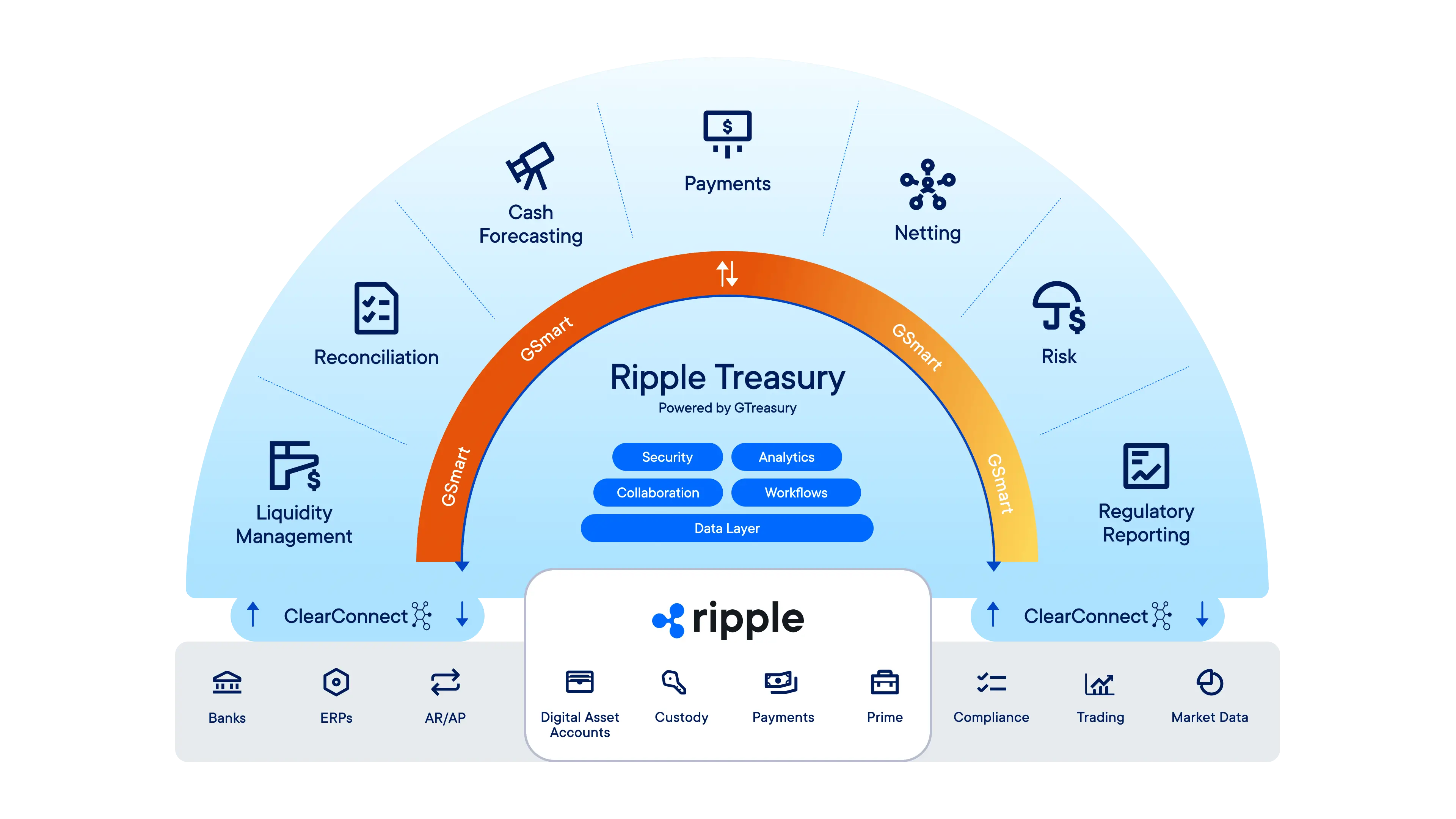
A transparent treasury analytics infrastructure is built on three distinct layers that turn raw financial noise into actionable liquidity insights. Think of it as a modern assembly line: data is collected, standardized, and then presented. Without this structure, treasury teams are left stitching together spreadsheets from disparate bank portals, a process that is both slow and prone to error.
Data ingestion
The foundation of the stack is the ability to pull data from hundreds of sources simultaneously. This includes bank statements, cash flow forecasts, and transaction logs from global banking partners. Modern systems use APIs to connect directly to financial institutions, eliminating the need for manual file uploads. This real-time connectivity ensures that the treasury sees what is actually happening, not what happened last week.
Normalization and processing
Raw data is rarely consistent. A transaction labeled "SWIFT Transfer" in one bank might appear as "International Wire" in another. The normalization layer maps these varying formats into a single, standardized schema. This step is critical for accurate aggregation. It allows the system to reconcile accounts across different currencies and regions, creating a single source of truth for cash positions and liquidity forecasts.
Visualization and reporting
The final layer presents the data in a way that supports decision-making. Dashboards highlight key metrics like cash coverage ratios, liquidity gaps, and investment yields. Instead of static reports, these tools offer interactive views that allow treasurers to drill down into specific transactions or simulate future scenarios. This transparency reduces the time spent on data gathering and increases the time spent on strategic allocation.
Legacy vs. modern infrastructure
The shift from legacy systems to transparent analytics is defined by latency and data depth. Traditional systems often rely on batch processing, meaning data is hours or days old. Modern transparent treasury analytics infrastructure provides near-real-time visibility, allowing for faster responses to market movements.
| Feature | Legacy Systems | Modern Analytics |
|---|---|---|
| Data Latency | Days (Batch) | Near Real-Time |
| Data Sources | Limited, Manual Uploads | Hundreds via API |
| Reporting | Static PDFs/Excel | Interactive Dashboards |
| Reconciliation | Manual, Error-Prone | Automated, Standardized |
Market trends and adoption
Adopting transparent treasury analytics infrastructure requires evaluating the reliability of data sources and the robustness of the underlying technology. Compare the source, the system's visible condition, the provider's technical expertise, the security certifications, and the integration plan before you commit. A good purchase path should make the data's health easier to verify, not harder.
Pause before paying if any part of the chain is unclear. Confirm the exact data feeds, API timing, security protocols, return policy, and the resources you need at home for the first week.
What transparent treasury analytics is not
It is easy to confuse transparent treasury analytics with standard accounting, but the two serve different purposes. Accounting records what has already happened; it is a historical ledger of transactions. Transparent treasury analytics, by contrast, focuses on what is happening right now and what might happen next. It aggregates data from bank statements, cash flow projections, and internal ledgers to provide a live view of liquidity. Treating it as a simple bookkeeping tool misses its core function: predictive insight and real-time risk management.
Another common error is assuming these systems replace human oversight. They do not. Instead, they act as a high-fidelity dashboard for treasury teams. The software handles the heavy lifting of data normalization and anomaly detection, but financial professionals must still interpret the signals, make strategic decisions, and validate the models. Without human judgment, raw data can lead to misinterpretation. The goal is augmented intelligence, not automation without oversight.
Finally, transparency does not mean exposing everything to everyone. It refers to the clarity of data lineage and the auditability of the analytics engine. Stakeholders need to trust where the numbers come from and how they are calculated. This internal visibility ensures that when a CFO questions a cash position, they can trace it back to the source transaction. It is about trust through clarity, not public disclosure of sensitive financial data.
No comments yet. Be the first to share your thoughts!